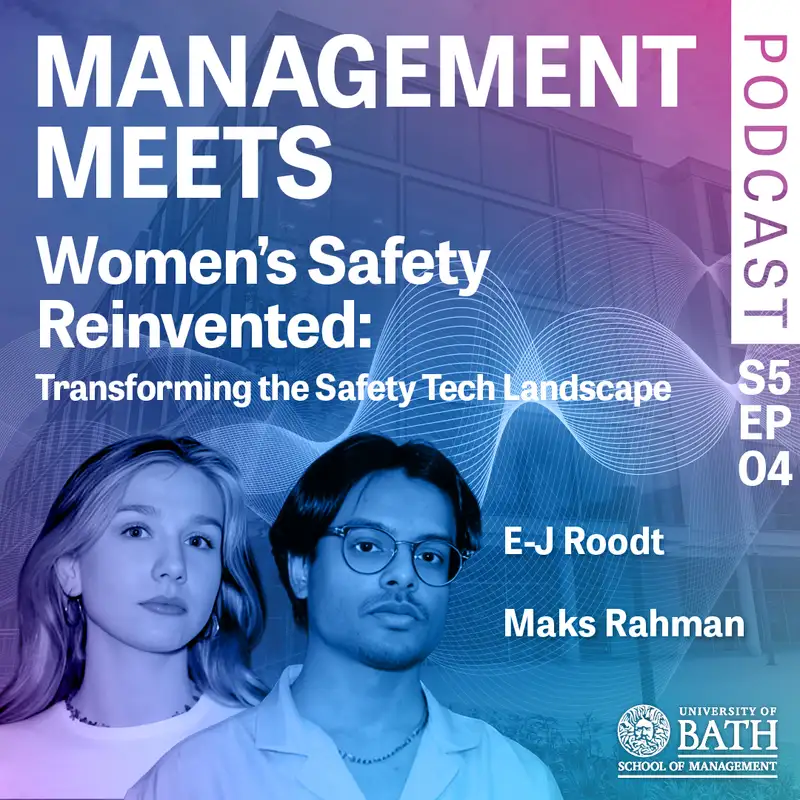
Women's Safety Reinvented: Transforming the Safety Tech Landscape
Management Meets — Season 5: E-J Roodt & Maks Rahman, EPowar
*This transcript has been edited for brevity and clarity.*
E-J Roodt:
It was really bad. I had to go to the hospital and I was quite unwell for a few days, but it was all worth it in the name of EPowar!
Katie Calvert-Jones:
Welcome back to Management Meets, the University of Bath School of Management podcast. Today, we are diving into the story of two incredible founders who together are revolutionizing personal safety through innovation and determination.
Joining us are E-J Roodt and Maks Rahman, co-founders of EPowar. EPowar is a personal safety app that uses wearable tech to automatically detect physical distress or violent attacks, alert emergency contacts, and record evidence.
Having met right here at Bath, E-J brought the idea and business plan, and Maks brought the tech knowledge and capability, building EPowar right out of their respective degrees: E-J from the School of Management, and Maks from Engineering.
Welcome both to Management Meets. Maks, it's lovely to meet you!
Maks Rahman:
Hi, Katie. Thanks for having me. I can finally check this off my bucket list!
Katie Calvert-Jones:
Excellent. And E-J, welcome back!
E-J Roodt:
Hi again! Thank you so much for having me again and for letting me bring my co-founder.
Katie Calvert-Jones:
We love welcoming guests back, and frequent listeners will no doubt recognize you, E-J, from our very first series—episode six, where we met you alongside Rob Holsinger, founder of Bubba Hospitality Group, and you gave us great insight into life as an entrepreneur. Check that out, listeners, if you haven't already!
Two years on, we're really looking forward to hearing more about EPowar in the time since, and of course, talking to co-founder Maks.
First, E-J, for any new listeners, tell us where the idea for EPowar first stemmed from.
E-J Roodt:
I was in my second year at the University of Bath, and it was a couple of things. First, there was a man who was following girls home on my road, so we were all quite scared. Then my mom sent me a rape alarm in the post, but I very quickly realized how difficult it would be to use if I actually needed it. You have to have both hands available to pull it, and I set it off accidentally once and nothing happened—no one came.
A few months later, right at the start of lockdown, I was watching an Apple keynote speech where they talked about how the Apple Watch was being used to detect heart attacks. That gave me the idea to use wearables to detect physical attacks.
I had just met Maks a few months earlier doing an optional German class together, and I knew that he had built some very cool things. I reached out to him and said, "Do you think that we could build this?" Now, nearly six years later, it's an app with 40,000 users.
Katie Calvert-Jones:
Amazing! Maks, bringing you in at this point: that optional German class—who would have thought you'd be approached with this question? What did you think when E-J first approached you?
Maks Rahman:
I didn't know what I was going into, that's for sure! I never thought about being an entrepreneur or building startups or anything like that. It was just one problem where she was like, "Do you think we could detect this? Do you think we could make something that does this?"
And I was like, "Yeah, sure. I think we can." And six years later, here we are!
Katie Calvert-Jones:
You both actually leveraged your final year at Bath as students to build the foundation of EPowar. E-J, you ran it as your placement and final project, winning a number of prizes throughout the process, which allowed you to go into full-time development upon graduation.
Maks, you developed the core intellectual property as your final year project, right? Can you talk us through that a little bit more?
Maks Rahman:
We got permission from the university to work on the core system—specifically how attack detection worked—as my final year project. It would have been a lot to try and complete a standard degree project and build EPowar at the same time.
None of the offered projects really appealed to me anyway, so one of my lecturers from a group project kindly agreed to be my supervisor, and I managed to build that for my final year project.
Katie Calvert-Jones:
E-J, tell us about your experience then. What was it like for you to have your final year project associated with EPowar?
E-J Roodt:
It was a really interesting project. We focused on the fundraising gender gap. What was most interesting was finding the theoretical outcomes and then, a year or two later, experiencing that gender gap in real life and seeing how real it was.
Having something on-theme with EPowar was really helpful. My business mentor was also our supervisor for the project, which was really nice, and we got the highest grade in the cohort, which was amazing.
Katie Calvert-Jones:
Congratulations for that! You won multiple Santander Awards and School of Management Dragons' Den competitions. How important was that in supporting your ambitions for the business, and in making you feel that this was something you could plausibly pursue full-time?
E-J Roodt:
It was hugely valuable—especially those initial Dragons' Den competitions when we first had the idea. It taught me the structure of a pitch and a business plan, and all the different factors you need to consider.
We got initial funding through those competitions, which helped us buy the watches we used for testing. We also had to buy a MacBook, because you can't build Apple apps on a non-Apple computer!
Then we won the Alumni Award right as I was finishing university, which covered a salary for me for a year so I could work on it full-time out of university, as well as providing additional funding opportunities for the business.
Katie Calvert-Jones:
I understand that during those early days, you became friends with a number of other entrepreneurs, including Navjot Sawhney, founder of The Washing Machine Project. For those not familiar, it's a social enterprise that reduces the physical labor of hand-washing clothes in low-income communities by providing manual washing machines.
How important was having that peer network, and how has that friendship maintained?
E-J Roodt:
Having other entrepreneurs in your network who are going through the same thing—whether they are at the same stage, further ahead, or earlier along—is so helpful. People who are further ahead can give you advice. It also feels helpful when you speak to someone earlier in the journey, because it shows you how far you've come. It's important to pass it forward when others have helped you.
Katie Calvert-Jones:
Like EPowar, The Washing Machine Project ultimately addresses a problem that disproportionately impacts women and girls. Does that alignment of values resonate with you?
E-J Roodt:
Definitely. I am in awe of and constantly inspired by Nav and what they've achieved. I keep seeing them on big billboards around London now, which is really cool!
Maks Rahman:
A lot of people are making B2B AI companies, and that's a very different conversation and challenge compared to impact. Knowing other people in the impact space means we can share and navigate similar challenges together—like trying to figure out funding solutions while staying focused on making an impact.
Katie Calvert-Jones:
Do you find that having conversations with founders facing similar challenges is helpful in itself?
E-J Roodt:
We're currently working in an accelerator office, and many generic competitions have fewer impact startups.
Maks Rahman:
If someone told me they wanted to be an entrepreneur, I wouldn't necessarily tell them to go into impact—I'd tell them to do B2B AI SaaS! The investment climate at the moment is heavily geared toward that.
Katie Calvert-Jones:
E-J, your research at university looked at the challenges of being a woman in the fundraising space. Were you prepared for the reality of fundraising for an impact business?
E-J Roodt:
I wonder if I had known the full reality at the time, whether I would have persevered! A lot of standard funding advice is geared toward different business models or founders. You take that advice and wonder why you haven't raised millions already! There's a difference between expecting a challenge and experiencing it in reality. Expecting it doesn't make it easier.
Maks Rahman:
There's no amount of advice that fully prepares you for it.
E-J Roodt:
Ultimately, the difficult thing with impact is that we don't want end users to have to pay for the core safety service, which makes monetization complex.
Katie Calvert-Jones:
Was that mission clear to you early on, or did it develop over time?
E-J Roodt:
In the very first conversation I had with my mentor, he asked, "How are you going to monetize it?" It was never an easy thing to figure out.
In America, we could potentially charge a subscription model because consumers are used to spending on health and safety. But our mission is to have as many people using it as possible to change safety statistics. Putting a paywall against it limits product accessibility.
Maks Rahman:
From the development perspective, from day zero we tried to make it as accessible as possible. Early on we thought about making a custom watch strap, but that requires people to buy another device. We didn't want to add a "pink tax."
When configuring it for existing devices, we made sure to use sensors available in affordable wearables—accelerometers, gyroscopes, and heart rate sensors available in devices as low as £20. We wanted the barrier to entry for the safety features to be as low as possible.
Katie Calvert-Jones:
Let's look at what the product is now. How does it work, and how has it evolved?
E-J Roodt:
It's evolved a lot based on user responses. We didn't realize initially how important the evidence recording feature would be.
Now, you don't need a wearable device to use the app. One of our key features is that you can press SOS directly from your lock screen with one tap without unlocking your phone. That immediately records evidence and sends a critical alert to emergency contacts, overriding silent or "Do Not Disturb" modes.
The app records microphone audio, location, and logs precise timestamps into a CPS police-approved evidence pack saved to the cloud, so if your phone is lost or destroyed, the evidence remains secure.
By November, we are launching an emergency dispatch feature where a trained responder can listen in and escalate to the police if needed.
And of course, we have our USP: automatic attack detection, for which we now have granted patents in both the UK and the US.
Katie Calvert-Jones:
Congratulations! You mentioned gaining Secure by Design police accreditation. What does that mean for EPowar as a business?
E-J Roodt:
To work with the police in an official capacity, you need Secure by Design accreditation, managed by the Crime Prevention Initiative. They didn't have an official digital app accreditation until this year, and we were the first to receive it.
As a result, we can now work with the police formally. We are presenting to 200 police officers in November about our technology, which opens opportunities to offer our product to vulnerable users, such as survivors of domestic violence.
Maks Rahman:
From the tech side, it was super important to go through that process. We had to ensure the app couldn't be compromised, evidence couldn't be faked, data was stored securely, and no one could break into it.
In a climate where there are many new, unverified apps, having an official body test and accredit our platform proves to users that they can trust us.
Katie Calvert-Jones:
Maks, going through that rigorous verification process adds technical complexity, but it sounds like you welcomed that standard.
Maks Rahman:
100%! I'm a perfectionist. With security, decisions made early on require more work upfront, but ensure everything built afterward remains safe.
When I started making this app, I was fresh out of university without years of credentials to prove myself. Having an external accreditation validate my work makes me super proud.
In the startup world, the ethos is often "build fast, break things, fix later." But security can't be handled with quick hacks—it must be built correctly from the beginning.
Katie Calvert-Jones:
What is the current geographic rollout of the app, and what are your international ambitions?
E-J Roodt:
Currently, the app is live in the UK and Ireland. We have protected our intellectual property in other jurisdictions and fully intend to launch internationally.
Managing data storage compliance across borders adds complexity, especially considering the solo travel market where users travel internationally. Expanding globally is very much on our roadmap.
Katie Calvert-Jones:
You're building technology designed to protect people and serve society, which comes with distinct hurdles. What keeps you both going through the challenges?
E-J Roodt:
We are completely aligned on the mission. If another product existed that did everything we do, built by people with the same values and mission, there wouldn't be a need for us to exist.
But no other safety product offers an accessible service structured to record admissible evidence and incorporate automated attack detection. We feel that if we don't see this through, no one else will solve this specific technical problem.
Maks Rahman:
I wholeheartedly agree. We have a combination of passion for the cause and the technical capabilities to deliver the solution. If others could or wanted to build this, they would have by now.
When we get deep in the weeds, what keeps us going is user feedback. Recently, our UX designer, Valesca, put together a poster featuring user comments from our videos and the app. Seeing real responses and knowing what the app means to people reminds us who we are doing this for.
E-J Roodt:
The empathy we bring to design is reflected in that feedback. We evaluate every detail to ensure it is easy to use in an emergency without increasing danger or enabling coercive control by abusive partners.
Katie Calvert-Jones:
E-J, could you read a few of those user comments from the poster for us?
E-J Roodt:
Sure!
"My mom is on EPowar with me and it gives her so much more security when I go out."
"Just wanted to say this is so brilliant. I've always been so cautious walking with my keys between my fingers."
"I only needed to walk a short distance between hotel rooms, but I felt so much better with the app in my hand."
"Honestly, this is a game-changing app. As a security specialist, I'll be watching how this blows up. Well done!"
"OMG, I love this so much. I need all my girlfriends to have this!"
Katie Calvert-Jones:
Those messages highlight how fundamental safety is to everyday life.
We recently spoke to Faye Jawad, founder of KRNL, who shared stories about testing EPowar in its early prototype phases—including an incident involving a concussion! E-J, what happened there?
E-J Roodt:
When we built our initial prototype, we needed to test if it worked by simulating physical falls and attacks. My friend Isaac used a move where he threw me over his shoulder.
Normally we did it on a mattress in my living room after moving all the furniture out. But during one test, I missed the mattress and my head bounced directly off the floor!
There's a video recording where you can hear Maks say, "I could hear it bounce!" I had to go to the hospital and was unwell for a few days, but it was all worth it in the name of EPowar!
Katie Calvert-Jones:
Incredible dedication—with a disclaimer to our listeners: please do not try that at home! Maks, what was going through your head?
Maks Rahman:
Honestly, I was so focused on getting the prototype to work that I didn't process it immediately! Everyone else was shocked, and I was just looking at the watch data asking, "Did it work?!"
In the video, you can hear Faye and her now-husband chatting in the background, and then total silence after the thud!
Katie Calvert-Jones:
A true keeper clip demonstrating your commitment!
Our motto at the School of Management is "Think Ambitious." What does ambition mean to you, Maks?
Maks Rahman:
For me, ambition means not being satisfied with the way something currently is, combined with the drive to stop at nothing to change it. It's saying, "I don't like this, I'm going to change it, and I won't stop until it changes."
Katie Calvert-Jones:
The mind of an engineer at work! E-J, what about you?
E-J Roodt:
Ambition is about stretching the limits of the status quo, and in the face of obstacles and rejections, continuing to push forward.
Katie Calvert-Jones:
E-J, Maks, what you have built with EPowar is incredible. Thank you so much for joining us on Management Meets!
E-J Roodt:
Thank you so much for having us!
Maks Rahman:
Thank you so much, this was really fun!
Katie Calvert-Jones:
E-J and Maks are true visionaries solving real-world problems, epitomizing the strength of partnering with someone whose skills complement your own. Their story is a reminder that big change can start in unexpected places—like an optional German class!
I'm Katie Calvert-Jones. Thank you for listening to Management Meets.
Creators and Guests