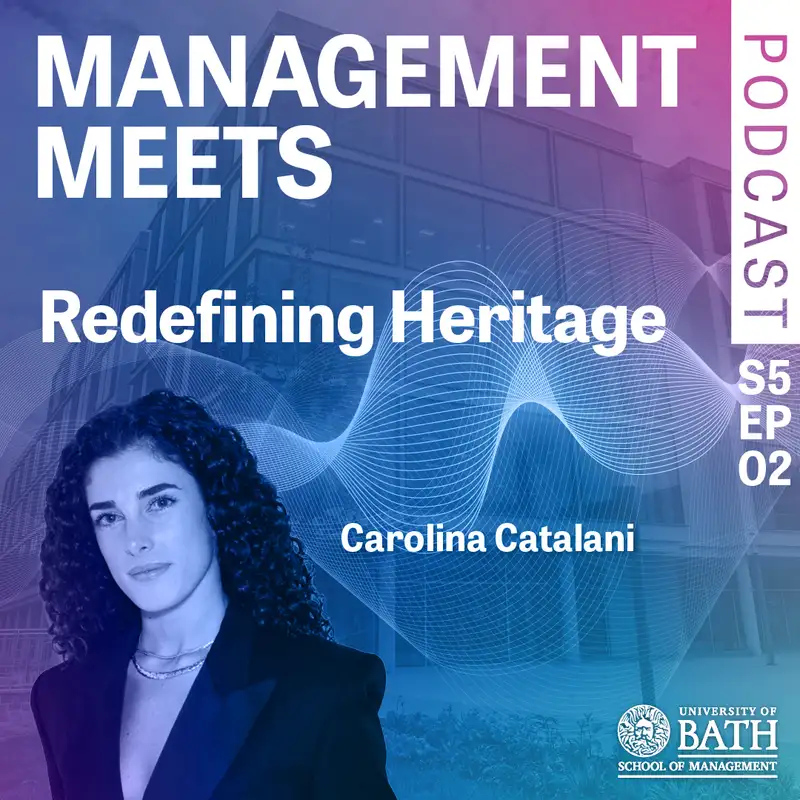
Redefining Heritage
Katie Calvert-Jones:
Welcome back to Management Meets, the University of Bath School of Management podcast. I'm your host, Katie Calvert-Jones. In this series, we're exploring entrepreneurship within our global alumni network. Today, we're stepping into the world of fragrance once again—a multi-billion dollar industry where heritage, storytelling, and attention to detail mean everything.
Joining us is Carolina Catalani, strategy and commercial director at Finmark, a fragrance distributor that has built and scaled over 25 luxury fragrance brands. Now, alongside her siblings, Carolina has founded perfume brand AVOU, recently launching their flagship store in Milan. Carolina, welcome to Management Meets. It's great to have you with us, and thank you so much for joining us from your holiday.
Carolina Catalani:
Thank you, Katie. It's so nice to be here. It's so nice to see you again after 10 years, which is crazy. But I'm so happy to be here and speak about my experience and AVOU.
Katie Calvert-Jones:
Thank you so much, and I understand you're with us from a bustling cafe, so we may hear a little bit of chatter.
Carolina Catalani:
Exactly. I'm on an island in Greece. I'm with friends, so maybe you'll see some other guests joining the call along the way!
Katie Calvert-Jones:
Oh, fabulous. I wish we could be there, too. Well, we'd love to hear all about your entrepreneurship journey, but let's start a little bit further back. Starting from the beginning, from our point of view, you studied international management with us at the School of Management, which is how we know each other. What led you to Bath?
Carolina Catalani:
Literally the idea that I would have work experience. That was the reason why I joined Bath, because I knew Bath was an exceptional school for work experience, which is what I wanted during my studies. I wanted to get that taste of what it means to work in a real job, so that's why I joined.
When I applied, I was studying GCSEs in an English school. You could put four or five choices of university, and I applied to two courses at Bath—that's how much I wanted to come to Bath, which is funny.
Katie Calvert-Jones:
Amazing. I didn't know that, so you were absolutely set on Bath from the outset.
Carolina Catalani:
Certain! I was certain I wanted to come to Bath, and then my sister joined, too, so it was a word-of-mouth thing as well, which is nice.
Katie Calvert-Jones:
Fantastic. Well, we'll talk more about your sister in a moment and that family dynamic, but I really want to start with Finmark. It's a family business founded by your parents in 1998, and it has been acting as a premier distributor in Italy since then. Italy is often seen in the industry as being ahead of the curve when it comes to perfume trends. What is it about the Italian market that makes it such a trendsetter for the rest of the world?
Carolina Catalani:
Good question. Italy has so much to offer in terms of how different it is from north to south. We speak different dialects from north to south and we drink coffee in different ways. It's as if there are many countries in one country, and that makes it extremely interesting to visit, learn about, and understand. I feel that's what makes it a place to watch out for, a place to be, and a place to visit.
Katie Calvert-Jones:
So you've grown up understanding that perfume environment. Your core model at Finmark has been taking a brand from obscurity and nurturing it into success until a retail giant acquires it. As a business model, how hard is it emotionally and strategically to build something so successful, knowing the ultimate goal is often to let go?
Carolina Catalani:
That's a very good question. As a distributor of perfumes, you know that is mostly what's going to happen, so it's part of the game. You should never go into it with an emotional attachment where you view your role no longer being needed as something negative. If anything, you should feel proud that you were part of that growth and success.
I can bring a couple of examples: two major brands in niche perfumery, Parfums de Marly and Initio. We were the first distributors for them 10 or 15 years ago, and recently they got valued at more than $2 billion. For me, it's a point of pride to say we were part of that success. We were their first distributors, which makes it even more special.
The most important part of it, however, is that you need to already have other future billion-dollar brands in your portfolio that will eventually become that in the next couple of years. It's a game of catching the good fish before anyone else. We've been really good at that since Finmark's inception in 1998. We've always been ahead of the curve in seeing trends and spotting brands with potential before they became big.
Katie Calvert-Jones:
Before we move on to your new venture with your siblings, let's focus a little bit more on Finmark. Over the last decade, you and your siblings have stepped into the business alongside your parents at various points. When became the right time for you, and how are you navigating the family dynamic? There must have been a huge shift going from being Carolina, daughter of the founders, to Carolina, who works for the founders who are also her parents, alongside her siblings. How do you shift that family dynamic to a professional one?
Carolina Catalani:
It happened in a very natural way because my parents founded the business. My mom is Colombian and my dad is Italian. They fell in love, my mom came to Italy, and they've always involved us in business decisions. My mom would bring products home for me to test out—new products that would eventually become huge. We've always had family and business merged together, so we sub-consciously had this dynamic as kids throughout our lives.
We never thought we'd end up coming back to the business, because our parents would always tell us, "Leave. Don't come back, leave." That's why we went to university in the UK. That's why each one of us did different things before coming back to the family business, which I think is really important: to get experience outside and then bring it back. I worked at Procter & Gamble thanks to Bath—that was my placement year job.
The most important part of it all is to learn and then bring it back to the business. When we came back—we all came at different times: my brother came back 10 years ago, I came back five years ago, and my sister came back two years ago—we had moments where we had to figure out how to manage the sibling, father, mother, and kids dynamic.
It all comes down to communication, respect for each other, and trust. We learned these values from our parents. In a lot of family businesses, it can be very rigid, like, "It's been this way until now, and nothing is going to change." Whereas our parents really listen to us and are really open to change and understanding what can be done differently. That helps us bring new ideas and put them into practice. So, a lot of communication, speaking, and listening.
It sounds like therapy, but it's true! Whenever we have new people joining our team, it's so much more about values than skills. Skills you can learn on the way—you just need to be curious, passionate, and want to learn—but the values need to match.
Katie Calvert-Jones:
Let's talk about that a little more. You've developed the business to bring in people from outside the family. How does the model shift? You speak about values, and we know that the business was born out of personal passion between your parents. What does your current hiring process look like?
Carolina Catalani:
It was a learning curve for me, because I had never hired people before. It's something you should learn before you do it, but in an entrepreneurial setting, you just learn as you go.
At the beginning, I was hiring based on skills rather than values. It was very much, "What have you done? Does it match the profile I'm looking for?" It was all about how good they were at doing specific tasks. But then people would come into the business and they just wouldn't match our way of working, because we have a very unique way of working that matches our values.
I shifted that completely and started hiring on values rather than skills, because we can transfer the skills to the person. That flipped the switch for us in choosing the right people.
It's really hard to find people who are as passionate and invested as us, because we've lived it since we were born. I've had to learn to put that into perspective and never expect people to be at that exact same level. But I need a certain level.
I am very open, direct, and transparent with any new joiner. I open the conversation saying, "This is who we are. Are you interested, and do you like this environment?"
I've also added a day with us in the office, which I think is very important. A candidate spends a day in the office so they can see the vibe. It's a lot about vibes and how they feel. That has made such a difference in the hiring process, because both sides get an idea of whether they like the environment or if we like the person.
It's been a learning process. I started hiring three years ago, and now I have a very strong team. I'm looking to grow the team, so if anyone listening wants to join us, feel free to text me! But I now have a very strong team and I'm really happy with it.
Katie Calvert-Jones:
It sounds like a true values-led organization. We've spoken a little bit about the heritage of the company born out of your parents' love years ago, siblings joining, and now the three of you—you, your sister, and your brother—have successfully launched your own brand, AVOU. Talk us through that process. How did that come to be, and how did you go about it?
Carolina Catalani:
As a family business, we are distributors, right? We're the middleman between brands and retailers, who then sell our products.
Our story actually starts in the 1980s because our granddad was a retailer. He opened the first perfumery in the Vatican City. My dad worked on the retail side of things, then decided to become a distributor and move up the chain. He was able to do that because he knew exactly what a retailer needed, so as a distributor, he could give retailers the tools they needed to sell the brand.
Now as distributors, we know everything that is needed for a brand to truly grow, and we have case studies that show that: Parfums de Marly, Initio, and Amouage, which is another well-known niche fragrance brand where a 25% stake was acquired by L'Oréal at a valuation of more than $3 billion a couple of years ago. We were the first distributors for each one of them.
We can spot a brand and know what it needs to become really big in the market. My dad always had the idea that he wanted to move even higher in the system: from retailer to distributor to producer. But he never thought the timing was right—and timing in general in business is extremely important.
When the three of us came back to the business, we brought very different skills. My brother is extremely creative and artistic. I'm very numbers-oriented, organizational, strategic, and business-focused. My sister was the cherry on the cake because she's always had a more developed nose than all of us. When we had breakfast together as a family, the bread would always burn and she would smell it before any of us. Growing up, it was something we knew, but we never gave it importance.
Then she decided to do her master's in Grasse, in the south of France, and study perfumery to become a perfumer—a nose. She went to London and worked at Floris London, the most ancient perfume brand in the market. She was the perfumer for Floris for around two or three years and created their last fragrances.
That's when we had a moment where we said, "Maybe it's the right time to take that step, because we have such different but complementary skills." Three years ago, we spoke as a family and said, "What if we do this?"
What was nice was that our dad, as his dad did for him, told us, "If you guys want to do this, it's your thing. It's a new entity, and it's your responsibility." That's how the idea came about to start three years ago.
Katie Calvert-Jones:
It's another wonderfully personal story. AVOU stands for "A Vow For The Day." How do you translate a personal, emotional memory into a commercial brand identity? How do you take that beautiful story of three siblings coming together and make a commercial success out of it?
Carolina Catalani:
That was the hardest part of the process. We sat on the floor for months. Our dad would come in and say, "Guys, you're not working. Come back to the office!" We said, "Dad, we need to brainstorm," because we didn't know exactly what we wanted to do.
We spoke about bringing our mixed cultures to life. We spoke about bringing our history to life—Vatican City, the three siblings, all this storytelling. But at the end of the day, we didn't think that would fully connect with the end consumer. Why is our story important? It's not more important than any other person's story.
That's when we came down to one question. We would sit together and ask, "Why is perfume so important to us as siblings? Why do we feel naked if we leave the house without perfume?"
The answers were different and personal. I would say one thing, my sister would say another, and when we extended that question to friends and family, everyone replied in different ways.
That reminded us of a little ritual our mom would always make us do growing up. We were fortunate enough to have 60 or 70 fragrances by the door before leaving our house, on what we called the magic tray. Before leaving for school, our mom wouldn't ask, "Have you brushed your teeth?" or "Have you packed your lunch?" It was, "Have you worn the scent of the day?"
In that moment, we would choose a fragrance. It was a mix of different bottles, stories, and colored liquids, but it was about the connection between the liquid and us. It was a silent promise—a silent vow—that we would make to ourselves. If I had an exam, I wanted to feel confident, so I would lean into a specific scent that gave me confidence.
That's how the brand name came about. Whenever friends would ask, "What fragrance should I wear?", our response was always, "How do you want to feel today?"
We came up with a concept less linked to us as a personal story, because we truly believe the brand needs to live and grow without us right there. It needs to be detached from us while being relatable to everyone. That is the concept of AVOU.
Katie Calvert-Jones:
That is such a magical story, Carolina. I can picture your mom standing with a tray of wonders by the door in the morning! I love the way you've spoken about how scent makes the individual feel. You opened your flagship store in Milan during the second year of your business, which is a huge achievement. How did you bring that personal level into the store?
Carolina Catalani:
That was another big challenge for us. We were supposed to open the store in our third year, but because we were doing really well, we decided to pull it forward to the second year. We had six perfumes and a very big space, and wondered what to do.
If we made a classic, beautiful marble store, it would look like any other store and wouldn't tell our story. It wouldn't stand out compared to big brands we're competing against.
It felt natural for us to ask, "What if we make it our home?" If you come to our house, we have this magic tray, but we also have perfume everywhere—in the living room, in the kitchen, everywhere. We thought, "What if we open our doors to our home?"
We pitched the idea to friends of my brother who run an architecture design studio called Crosby Studios. We didn't think they would want to work with us because they work with very big brands, but they fell in love with the idea of opening up the home of AVOU.
They created a render of our actual family home for the store, which was a bit freaky because we thought, "Okay, maybe this is too personal and traditional." We wanted to make it modern and more reflective of AVOU, so we created a space inspired by home.
You walk into the store and have a living room section. Every detail tells our story. You walk in, and on the left is a living room with a couch featuring a pattern inspired by Vatican City frescoes, along with illustrations of our dogs, since we always have our dogs with us.
On the right side, before leaving the store, you have a reinterpretation of the magic tray. We brought that ritual to life in the store so people can experience it as they leave.
The most important part of the store is the second room: our kitchen. It's an industrial-style kitchen, and it's the heart of the store. For us, the kitchen has always been the heart of the home. It's where AVOU was born as an idea, where Katya brings her perfume trials for us to try, and where we have deep conversations and laughter.
It's interesting to see consumers come in, drawn to the kitchen, and feel at home. It doesn't feel like you're trying to sell anything. We have a coffee machine and a fridge where we plan to do smoothies—it's an experience of chilling together and smelling perfumes.
It's been doing really well. From a business perspective, I had budgeted it under marketing, so I wasn't expecting a direct return so soon, but it's been performing well financially, which shows the concept works.
Katie Calvert-Jones:
I love that you've always got your eye on the numbers alongside the story. You brought this concept to Paris Fashion Week as well, right?
Carolina Catalani:
Yes. We tested the kitchen concept during Paris Fashion Week first, because it's unusual to combine a kitchen and perfume. We set up our kitchen in a gallery there, and it did so well that we said, "This makes sense—let's bring it to Milan." That's how we opened our AVOU home in Milan.
Katie Calvert-Jones:
How was Paris Fashion Week?
Carolina Catalani:
It was really good. As a distributor in our family business, we've always concentrated our energies within the perfume industry—going to perfume fairs around the same people and segment. It was very interesting to bring our product into another segment: Fashion Week.
It's interesting how you can get inspiration from other industries. We actually launched AVOU during Design Week in Milan. Having an open mind and looking beyond your immediate industry inspires you and expands your consumer base. People attending Paris Fashion Week or Design Week are the same consumers who want to buy a cool perfume with nice storytelling. Broadening your horizon beyond your niche is a very important learning.
Katie Calvert-Jones:
That's fantastic, Carolina. You've spoken about how the business has grown, the dynamics between you and your siblings, and the different skills you bring. It sounds like you've been incredibly busy. How do you balance that and make sure you take time out as an individual and as a family?
Carolina Catalani:
Very hard question! If you decide to run your own business and work with your family, you need to accept that the majority of your day-to-day life will be working on your business. That's a life decision you make. When I worked at Procter & Gamble, it was very structured: when I was on holiday, I was on holiday. I had to learn that I had chosen a different life when I came back to work for my family business.
We had to put boundaries as a family based on what works for each of us. I'm a super early bird: I wake up early and I'm ready to speak about business, but I'm in bed by 9:00 PM. My brother is the opposite—he's a night owl, and his best creative ideas come when he's working out after work. It has taken an understanding of what works for each of us and respecting that.
For example, when we were in New York shooting a campaign for AVOU and nothing was confirmed yet, my brother said, "I need to go for a run." My sister and I thought, "Everything is going wrong, but fine, go for a run." He managed to figure everything out on his run!
You need to learn what is important for you and make it a priority. My morning routine is super important to me: I wake up early, work out, and follow my schedule. As long as I have that, I'm ready to approach the day. My sister doesn't want to speak early in the morning, so I don't speak to her in the morning! It's about understanding what works for each person and respecting that within a busy day.
Katie Calvert-Jones:
At the beginning, you likened the business dynamic to family therapy, recognizing the differences between each of you. It's very endearing and practical.
Carolina Catalani:
People ask us how we work together, and that's the answer. We've always had open communication as siblings. I've always been the mediator between my brother and sister, who are both very artistic, so I brought that sibling dynamic into the workplace.
Choosing the right people you work with is a game changer. When partnerships and synergy work well, it makes a huge difference. When it wasn't working well—even between us siblings—working was much harder.
We've had moments like that. When my sister joined as the youngest, we had to switch our mindset from seeing her as the little one to seeing her as a full colleague. Just because we're older doesn't mean her ideas are less important. Choosing the right people is essential in business.
Katie Calvert-Jones:
Before my final question, you spoke about coming to Bath for the placement opportunity and working at Procter & Gamble, where you also worked after graduating. Could you speak about how that placement helped prepare you for where you are now?
Carolina Catalani:
I was at a different stage of my life back then. I knew I wanted to work somewhere that would give me structure, because that fits my personality. I wanted to learn and build a foundation. When I joined Procter, I loved the job, grew fast, and absorbed everything like a sponge.
I decided to leave Procter because of a dream I had about working back in my family business. I had come home during COVID, which accelerated things, and I wanted to be part of the family business conversations in an active way.
When I told my parents, "What if I come back?", they started crying. They were happy, but also scared about the responsibility of me letting go of a job at Procter. The first thing my dad said was, "I hope I can give you what Procter or any other company out there would give you."
Since being back, I've focused on bringing that Procter structure to the family business, which really helped. I even poached my ex-boss from Procter to come work for our family business before I joined! Bringing those skills, building on them, and molding them into a business is important. My brother and sister did the same from their previous roles, and taking time away brought the three of us back at the right moment.
Katie Calvert-Jones:
The School of Management motto is "Think Ambitious." What does ambition mean to you?
Carolina Catalani:
My parents came from nothing and built their business by themselves through sacrifice, ambition, and hard work. They reinvested what they made into our education and the business.
What we tell each other as siblings is: they brought us here, and we want to go even higher. There are three of us and there were two of them. Ambition means appreciating everything we already have, where our parents brought us, and the opportunities we've lived, while taking it a step further. We've always been ambitious as siblings, so for us, it's about taking things even further.
Katie Calvert-Jones:
Without a doubt, Carolina. Thank you so much. What a wonderful conversation. Thank you for letting us into your family business, your home, and your kitchen, and we look forward to following your journey!
Carolina Catalani:
Thank you, Katie. It was so nice to speak to you!
Katie Calvert-Jones:
Let me know next time you're in the UK and we'll catch up!
What a fascinating look at the intersection of family heritage and modern retail strategy in the perfume industry. I'm Katie Calvert-Jones. Thank you for listening to Management Meets.
Creators and Guests